Jimmy Carter Presidential Library & Museum
Atlanta, Georgia
Photos and text © Gleaves Whitney 2005
-

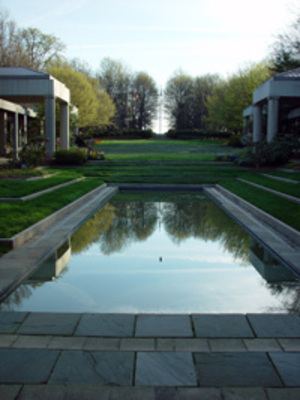
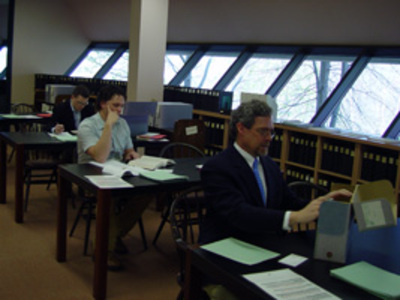
An early April morning at the Jimmy Carter Presidential Library and Museum. The buildings are beautifully situated in 35 acres of woods between downtown Atlanta and downtown Decatur.
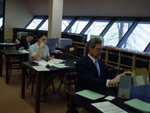
The Carter, one of 11 presidential library-museums administered by the National Archives and Records Administration, contains more than 27 million pages; one million feet of film; 600,000 photographs; 2,500 hours of audiotape; and 1,200 hours of videotape.
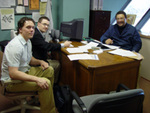
Taking advantage of this outstanding resource on a recent research trip were Hauenstein Center director Gleaves Whitney and leadership fellows Brian Flanagan and Eian Gilbert. -
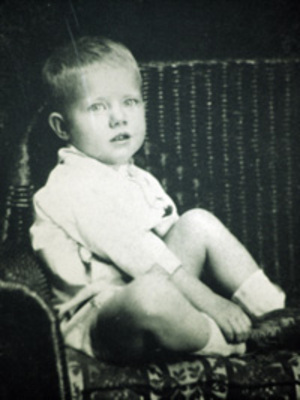
Jimmy Carter has spent much of his life in the rural South, about two hours' drive south of Atlanta. He grew up not in Plains, as is widely believed, but in Archery, Georgia, on his parents' farm. This photograph was taken in 1926, when he was two.
Jimmy Carter described his father as a "stern disciplinarian." "My most vivid memory of a whipping," Carter wrote in his first autobiography, "was when I was four or five years old. I had been to my Sunday School class, and as was his custom Daddy had given me a penny for the offering. When we got back home, I took off my Sunday clothes and put the contents of my pocket on a dresser. There were two pennies lying there. Daddy thus discovered that when they passed the collection plate I had taken out an extra penny, instead of putting mine in for the offering. That was the last money I ever stole" [Carter, Why Not the Best?, p. 19]. -
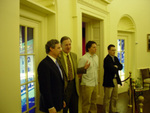
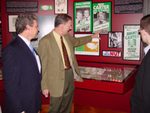
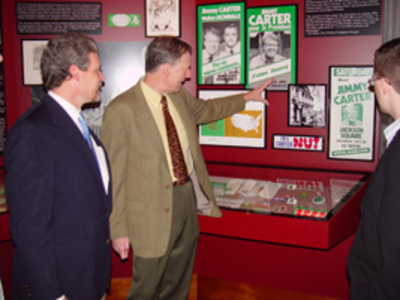
The director of the Carter Library, Jay Hakes (second from left), led Gleaves, Eian, and Brian on a tour through the museum. Here they stand in a meticulous reproduction of the Oval Office as it appeared between 1977-1981. Because the 39th president is a graduate of the U.S. Naval Academy, there are numerous nautical objects in the Oval Office. There is also a bust of Harry S. Truman. On the desk is the famous plaque associated with Truman, "The Buck Stops Here," given to President Carter by Margaret Truman.
-
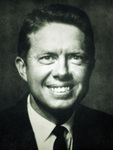
Jimmy Carter's political career began at age 39 when he successfully ran for the Georgia Senate. The U.S. president at that time was another Democrat, John F. Kennedy.
This photograph of Carter was used in campaign posters and literature during that first successful campaign. Moving to Atlanta, he served in the Georgia legislature for two terms, from 1963-1966.
-
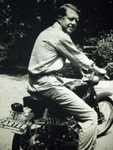
Jimmy Carter lost his first bid for governor of Georgia in 1966. He was not well known and it was during this campaign that some journalists first dubbed him "Jimmy Who?" The phrase would be resurrected a decade later when Carter seemed to come out of nowhere to run for president.
The 1966 loss, Carter later wrote, "was extremely disappointing." He ended the campaign "deeply in debt." The race had also taken a physical toll. He had started the campaign weighing 152 pounds. On the campaign trail he lost 22 pounds, and was down to 130 by November [Jimmy Carter, Why Not the Best?, pp. 130-31].
Despite the emotional, financial, and physical toll of the '66 campaign, Carter would run for governor again in 1970. He vowed to win -- and did.