
Abraham Lincoln Memorial
Washington, DC
Photos and text © Gleaves Whitney 2004
-
The Lincoln Memorial, near the Potomac River, presides over the west end of the National Mall in Washington, DC. At the other end of the Mall, two miles to the east, rises the U.S. Capitol. The visual axis formed by the Lincoln Memorial and U.S. Capitol creates one of the most meaningful vistas in the American landscape.
-
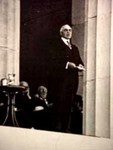
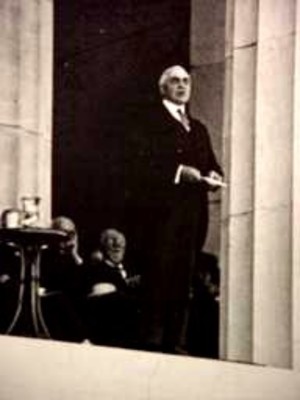
The Lincoln Memorial was dedicated on May 30, 1922, when former president William Howard Taft presented the finished structure to sitting President Warren G. Harding and the American people. More than 50,000 guests were on hand for the ceremony, among them a row of Union and Confederate veterans.
The history of the Lincoln Memorial goes back to 1901, just 36 years after the 16th president's assassination. That year four of America's leading artists came to Washington to recommend ways to beautify and dignify the national capital. After all, the Spanish-American War had confirmed the U.S. as one of the world's great powers; it needed a national capital whose grandeur reflected its new international standing. -
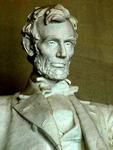
The artists' recommendations were published in 1902 in the McMillan Park Commission Report. A decade later, architect Henry Bacon began working on a design that satisfied the Lincoln Memorial Commission's charge that the structure evoke grandeur and republican simplicity. It is no accident that Bacon's design reflected America's vacillating aspirations to be both the world's greatest democracy and the globe's strongest power: the memorial to America's 16th president looks like an ancient Greek temple set in the Roman Empire.
Indeed, a prominent inscription on the inside of the structure refers to the memorial as a "temple" dedicated to Lincoln and the ideas for which he stood. More accurately, perhaps, it is a temple to American ideals in the early twentieth century -- union, freedom, democracy, and international power.
-
The groundbreaking ceremony took place on the 105th anniversary of Lincoln's birth, February 12, 1914. The memorial took eight years to construct. During that time, the U.S. was dragged reluctantly into the First World War, and President Woodrow Wilson tried to reshape American foreign policy "to make the world safe for democracy." Henry Bacon, watching the temple take shape, said the memorial would be "a fitting tribute to all who love liberty."
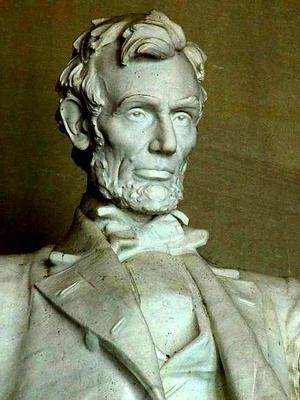
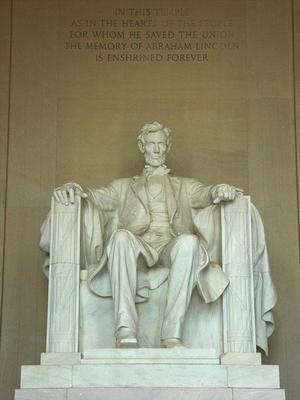
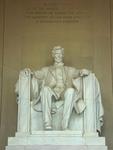
Lincoln Memorial, Washington, DC. The large statue of Abraham Lincoln sits on a "throne" inside his "temple." He was a Western president -- Springfield, Illinois, is on virtually the same latitude as Washington, DC -- so it is as if Lincoln were back in the West, facing east toward the seat of government on Capitol Hill.
Daniel Chester French was commissioned to design and sculpt the statue of the sixteenth president. It was made from 28 blocks of Georgia marble and took more than one year to complete. French was assisted by six brothers from the Piccirilli family. The inscription above Lincoln's head reads:
IN THIS TEMPLE
AS IN THE HEART OF THE PEOPLE
FOR WHOM HE SAVED THE UNION
THE MEMORY OF ABRAHAM LINCOLN
IS ENSHRINED FOREVER.